
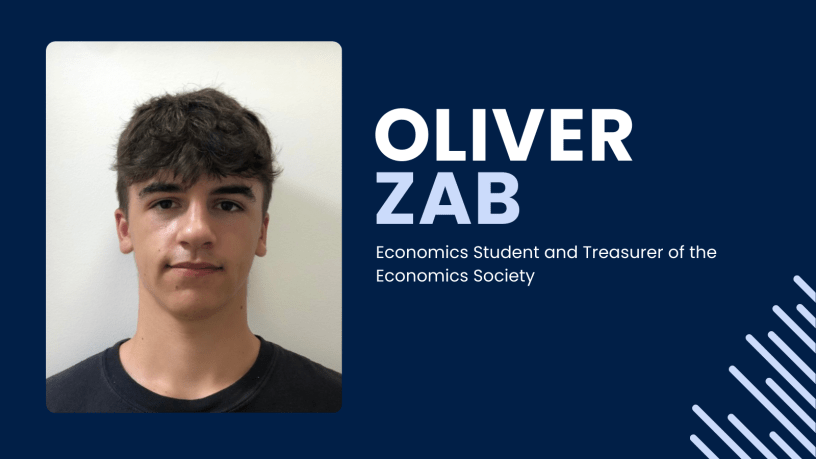
Meet Olie Zab, one of our third-year BA Economics students and the Treasurer of the Economics Society.
Explain your educational background and work experience so far?
I am currently studying Economics at Manchester Met. Alongside my studies, I work at a café, which has helped me develop strong communication skills, confidence, and the ability to work effectively in a fast‑paced environment. Through my part time job, I have met many students from across different universities in Manchester, allowing me to visit them in different locations such as Argentina.
In addition to my university and work commitments, I serve as an ambassador for Manchester Young Professionals. I’m the first student to take on this role, and it gives me the chance to attend networking dinners with around 50 professionals, build industry connections, and represent young people entering the workforce. As part of this I also participate in the Manchester Run Club, which is open to students and helps build a welcoming sense of community.
How did you find out about Economics Society and the Role?
When I first joined the university, the Economics Society didn’t exist. Because of that, I decided to create the society with other students, all in our first year at Manchester Met. From the beginning, I took on an active role in shaping the society, organising key social events and helping to build a sense of community among students interested in Economics.
In its early stages, we didn’t have external speakers, but one of our lecturers did come in to speak about the global financial crisis, which was a great starting point for academic engagement and the society.
During my second year, I didn’t hold an official role, but the society had already grown significantly and started attracting external guests.
As I started to notice the society growing, I had been informed about the role as a treasury which would be available for me to apply for in my third year. As the society developed, we hosted notable speakers such as Lord Peter Mandelson and Lord Peter Lilley. Lord Lilley even travelled from London to speak with our members.
We have also built a policy of maintaining positive, open relationships so that all students feel welcome to join the society and attend events.
Our aim is always to ensure that students gain something valuable whether academic insight, networking opportunities, or a stronger sense of community.
How did you apply and what had been the process?
When the previous committee members were preparing to go on placement, they let us know that positions within the Economics Society would soon become available. This created a natural opportunity for new students to step into leadership roles and continue the society’s work. I decided to apply because I wanted to get involved again and help keep the society alive and going. It was important to me that the society continued to grow, and that ambitious students could get the most out of it.
Since taking on the role, we’ve planned three more upcoming events. These include a session with an alumnus from the course who now works at Bloomberg and a talk about health economics from a senior lecturer at The University of Manchester.
What advice would you give to students about society opportunities?
My main advice to students is to take every opportunity to speak to others and make genuine connections.
Engaging with people from all different walks of life helps shape who you are and broadens what you know. It’s important that those connections are authentic, take a real interest in people, listen to their experiences, and make sure you approach every interaction with sincerity.
These relationships often become the foundation of personal growth, academic development, and future career opportunities.
Finding a mentor can also be incredibly valuable, but it’s worth understanding that mentorship can be hit or miss at first.
A good mentor will explain that not every pairing is a perfect fit, and sometimes it takes a little time to find someone whose guidance suits your goals and personality. When the match is right, though, mentorship can be transformative.
It had been my mentor that offered me a position in Manchester Young Professionals group.
For students studying Economics, I always encourage looking into internships or research placements especially during the summer between second and third year. These experiences help build both qualitative and quantitative research skills while giving you the chance to work on projects that have real meaning.
For example, over last summer I took on the role as a research intern at The University of Manchester. I contributed to projects related to mental health and NHS waiting times. Working with this data helped me understand how real policy decisions are made and gave me valuable experience that directly supported my dissertation. This had also helped me to develop skills that I can now use for my dissertation.
Overall, society involvement, mentoring, and internships are opportunities that can genuinely shape your university journey. They help you grow, gain confidence, and build the skills you need for whatever you choose to do next.
What has been you best experience as a student at Manchester Met?
My best experience as a student at Manchester Met has definitely been completing my three‑month full‑time research internship.
It was a real highlight of my degree and a turning point in my personal and professional development. I wouldn’t have been able to make the most of the experience without the knowledge and foundational skills I gained through my course. Having a solid grounding in Economics was essential, and it allowed me to contribute meaningfully to the projects I worked on.
The internship helped me grow not just academically, but also as a person. It gave me confidence, practical experience, and a clearer understanding of how the theory I’ve learned is applied in real‑world situations. It’s an experience that has genuinely shaped my future ambitions and strengthened the path I want to take after university, which is completing a Masters in Economics.
Is there anything else?
I would really encourage students to get involved in societies because there are so many benefits. Being part of a society allows you to meet new people, make friends you might never have crossed paths with, and hear ideas or perspectives that can genuinely broaden your horizons.
I’m particularly passionate about bringing speakers into the Economics Society because it exposes students to new ways of thinking and helps them understand what they can do with their degree. Hearing from people working in different areas of Economics shows that you can have a real impact and make a meaningful difference. That’s something I’ve learned during my time at university, and it’s shaped how I think about my future.
My final piece of advice is to take chances and step out of your comfort zone. Join clubs, attend events, and talk to people in different settings. These moments often lead to unexpected opportunities, and they help you grow in ways you don’t always realise at the time.
Created by Jessica Reynolds, Blog Interviewer & Content Creator
If you’d like to be involved in a future blog post, please do reach out: J.Reynolds@mmu.ac.uk
 Finance & Economics Hub