
- Please provide your educational background
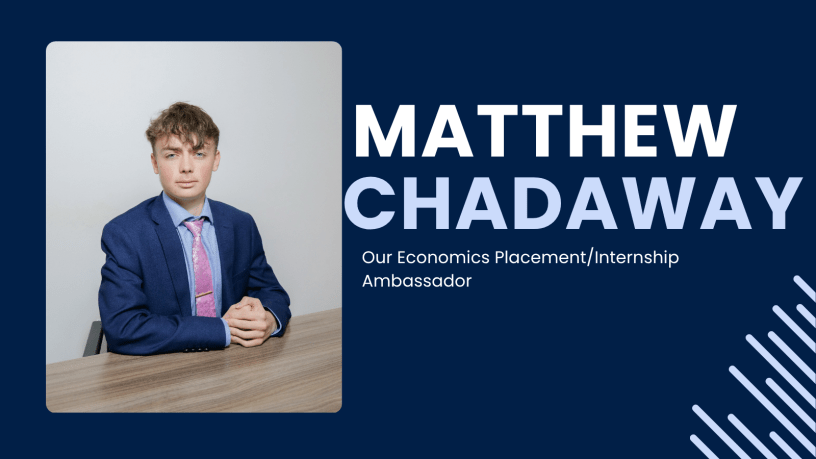
My name is Matthew Chadaway, and I’m a Level 6 student studying Economics. As part of my placement year, I worked in the mergers and acquisitions sector, supporting companies looking to acquire other businesses. My role involved assisting deal executives in preparing businesses for sale, and I was also responsible for managing my own portfolio of companies throughout the process. This placement ran from August last year until September this year, and it was an incredibly valuable experience that deepened my understanding of corporate finance and strategic business transactions.
After completing my placement, I returned to Sainsbury’s, where I took on a training role at a new store in Manchester. I worked closely with the management team during the store’s opening, helping to set up operations, manage cash handling procedures, oversee checkout counts, and support back-office banking functions.
In addition to my academic and professional experience, I’m proud to be a Placement and Internship Ambassador. This role allows me to support other students in finding and securing placement opportunities, sharing insights from my own journey, and raising awareness of the benefits of work-based learning. - Please explain your role and how you got it.
I first heard about the Placement Ambassador role through an email from my tutor. They asked if I would be willing to share my experience and offer advice to other students going through the placement process. As an ambassador, I help students feel more confident by answering questions about interviews, applications, and psychometric testing.
One thing I’ve noticed is that not many students make use of the Careers Services available at Manchester Met. Tools like CV360 and the Cover Letter Builder are incredibly helpful, but some students don’t even know they exist. Part of my role is to raise awareness of these resources and encourage students to take advantage of them.
It’s also important to give students a taster of what to expect during the placement process, so they don’t panic when things get real. I applied for my own placement through the Careers Service, which involved writing a CV and cover letter. The opportunity I applied for was exclusive to Manchester Met students, and it led to an interview and an assessment centre. That experience helped me understand the process more clearly and gave me the confidence to support others on their journey. - What advice would you give to students about place, graduate schemes and work placements.
One of the most powerful tools for building your career is LinkedIn. Make yourself visible share your experiences, showcase your achievements, and demonstrate your interests as much as you can. The more active and authentic you are, the more likely you are to attract opportunities and build meaningful connections.
Start by thinking about the modules you enjoy most and explore job roles related to those areas. Then, connect with professionals working in that industry. When I was on placement, I received messages through LinkedIn simply because I had made myself visible and shared what I was doing. I even posted the placement advert on my profile to see who I could connect with and at one point, I was in contact with a football club because of it.
I knew I wanted to go into corporate finance, so I made sure to engage with relevant content. Linking posts, commenting, and interacting with others in the field helped me stay informed and build relationships. You never know who might see your profile or what doors it could open. - What has been you best experience as student at Manchester Met?
One of the things I really value about Manchester Met is the support from lecturers and personal tutors. You can go to them about anything especially when it comes to finding a placement. My corporate finance lecturer was incredibly helpful, offering ideas and even reviewing my application to make sure it was strong. They genuinely want you to succeed and are happy for you to tap into their knowledge and experience.
The support doesn’t stop at placements either. Lecturers are also there to help with returning to university after your placement and guiding you through final-year projects. It’s a very collaborative and friendly atmosphere, where staff are approachable and invested in your development. - Is there anything else?
As a Placement Ambassador at Manchester Met, one of the key things I always highlight is the value of Manchester Met exclusive opportunities. These are placements that are offered specifically to Manchester Met students, which means you’re not competing with applicants from other universities. That gives you a real advantage.
I’ll be speaking to Level 5 students tomorrow about this, and my advice is simple: start by checking the Careers Service website. It’s full of resources and listings, including those exclusive opportunities. When you apply for one of these roles, you’re more likely to be successful because many of the employers already have experience working with Manchester Met placement students. They understand the structure, expectations, and how to support you effectively, which leads to stronger working relationships.
If you’re serious about securing a placement, make the most of what’s available to you. Use the Careers Service, ask questions, and don’t overlook the opportunities designed just for you.
Employability & Placements, Events and Opportunities, F&E Student Community
Student Spotlight – Matthew Chadaway
 Finance & Economics Hub