
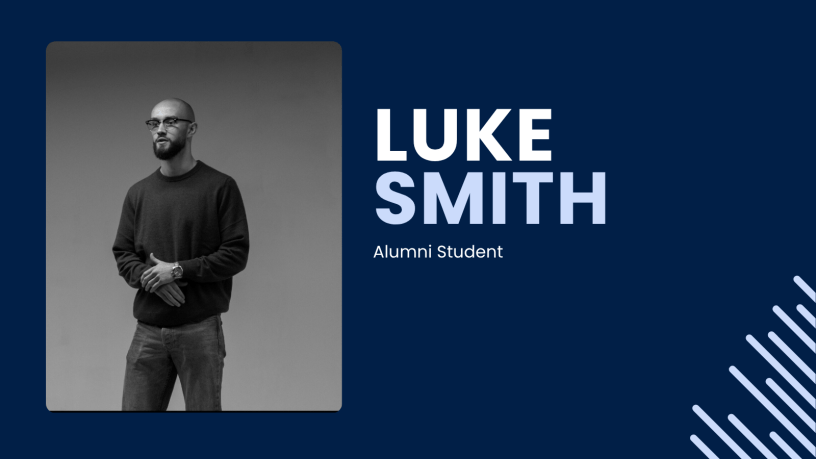
- Explain your educational background.
I studied Accounting and Finance for three years at Manchester Met University, I have just graduated this year. Before starting my degree, I took a gap year during which I worked in a call centre, I had learnt a lot there.
While at university, I also held a part-time job at Tesco too.
In my first year, I completed a placement focused on financial analysis for a not-for-profit organisation, where I hoped to support a small charity.
My second placement was at BNY Mellon, and I will be returning there to work. - What is your business or business idea?
In my second year, I took part in a case competition called The Ideas Festival. It was designed for students who had an idea they’d never had the chance to develop. The competition offered the opportunity to win funding, present to a panel of judges, and build valuable skills such as public speaking and pitching.
My idea focused on creating a data-driven solution for matchmaking in mixed martial arts. In organisations like the UFC, matchmaking is typically handled by two matchmakers who manually review the roster and decide who should fight next. My concept aimed to streamline this process using data analytics to support more strategic and transparent matchmaking. While inspired by the UFC, the solution was designed to be adaptable and applicable across the sport more broadly. - What had been your experience with the enterprise team at Manchester Met?
The Ideas Festival was advertised during lectures and on Instagram, which is where I first came across it. What really caught my attention was the tagline inviting students to share ideas they’d never had the chance to take forward.
To enter, I had to submit an application. After that, there were a couple of training sessions provided by the organisers. These included guided workshops on how to present and further develop our ideas. As part of the first round, I had a one-to-one interview in a meeting room where I discussed my idea in more detail.
I was selected to go through to the final round, which took place in an open-plan university building. Before the final pitch, we had a trial run to rehearse our presentations. The final pitch was delivered to a panel of judges.
As part of the process, I received SEED support to help bring my idea to life. The entire experience was not only about funding, it also included valuable teaching and development opportunities. - How did that help your idea/skills?
I found it really useful to practice public speaking and learn how to present my ideas clearly. As part of the competition, I had a set amount of time to pitch, which helped me develop the skill of explaining something complex in a simple and accessible way.
Being able to communicate ideas effectively and make them easy to understand is a valuable skill that I’ll carry forward into future opportunities. - What advice would you give to current students for setting up their business?
To succeed in opportunities like The Ideas Festival, it’s important to be able to speak articulately and confidently. You may need to present your ideas to people who are more senior than you, so it’s crucial to communicate clearly and concisely. Being able to convey your idea within a short time frame is a valuable skill, and it starts with clearly defining the problem you’re trying to solve.
Many students begin working on a project or idea without first outlining the problem. However, if you have an idea or product, it’s essential to take a step back and start with the problem. Once the problem is clearly defined, you can present your idea as a solution.
It’s also helpful to build a positive pattern of behaviour early on even from your first year. Consider your five-year or ten-year goals and let them guide your decisions and development throughout university. - What role are you in now?
After graduating, I secured a place on a graduate scheme that includes a two-year rotation. During this time, I will work across four different lines of business, spending six months in each area.
This structure is designed to give me broad exposure to the organisation and help me develop a well-rounded understanding of its operations. - What steps/preparations did you take to get there? How did this experience help.
During my second year, I applied for 104 graduate schemes and received three offers. One of those offers was from BNY Mellon, where I will be joining their graduate scheme.
To strengthen my applications, I completed several virtual experiences, including one with J.P. Morgan. I approached these opportunities with a genuine thirst for knowledge and a desire to learn as much as possible.
Last year, I founded the Finance Society at university. This academic year, I served as Chair and recruited a team to take on various roles. By the end of the year, the society had grown to 450 members. Through this experience, I built strong relationships across the university and developed leadership and organisational skills.
Everything I pursued was driven by passion. I believe that when you’re genuinely passionate about something, it naturally comes through especially in interviews and professional settings.
Here is the link for you to find out more information: https://www.mmu.ac.uk/careers/graduates/enterprise
RISE modules for Enterprise: https://rise.mmu.ac.uk/lil/enterprise/
Created by Jessica Reynolds, Blog Interviewer & Content Creator
If you’d like to be involved in a future blog post, please do reach out: J.Reynolds@mmu.ac.uk
 Finance & Economics Hub