
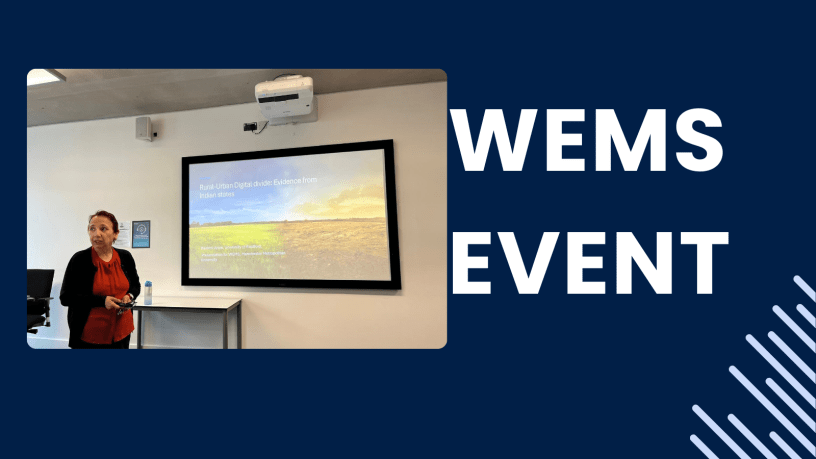
With the new academic year just around the corner, we are reflecting on the work WEMS has done over the past year while also thinking ahead. We have run 4 WEMS events last academic year: two events in semester one and two events in semester two. For the final WEMS event of the year we saw presentations by Sophia Kuehnlenz (Senior Lecturer in Economics, Manchester Metropolitan University), Rashmi Arora (Associate Professor in Development Economics, University of Bradford), the Corporate Women Society and Satveer Kaur (undergraduate economics student, Manchester Metropolitan University).
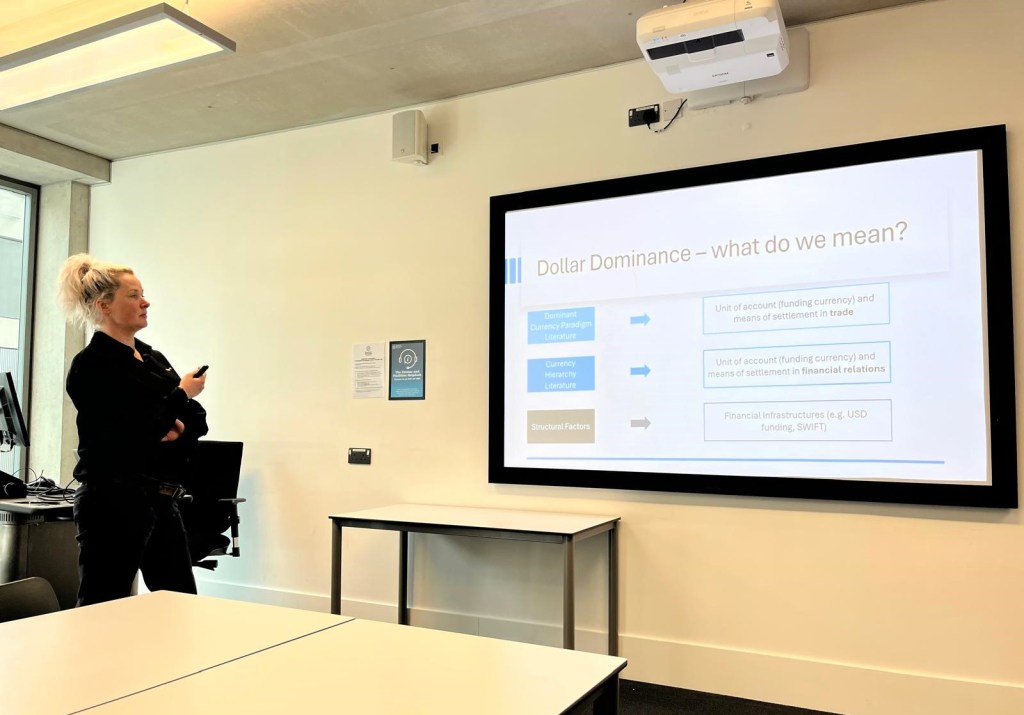
Sophia reflected on the current international financial and monetary system showing how the US dollar not only dominates this system via its reserve status and its share of export invoicing and FX transactions, but also via established underlying structures that consistently generate demand for the dollar. After contemplating on issues such as the unjustified unbalanced IMFS, dependency on the dollar provision by sovereign states as well as the inherent geopolitical power in tandem with a declining corresponding banking network leads to increasing costs and declining efficiencies. The idea of multicurrency CBDC arrangements was floated as a potential alternative to the current unipolar system. An argument was then made that CBDCs offer a unique opportunity to fundamentally change the IMFS and with that the geopolitical space countries operate in. However, when looking at the UK and research concerned with its retail CBDC (digital pound) it was argued that the lack of a strategic approach by recent governments has meant the research seems rather vague and unorganised. A commitment to introduce a retail CBDC is also still missing. Similarly, while the importance of transnational cooperation in the set-up of CBDCs, their underlying technology and regulatory framework was cited, the geopolitical considerations did, other than potential sanction evasion by other countries, not enter the discussion, at least not from a government perspective. It was noted that, this is fundamentally different from the private sector view who attributes huge geopolitical importance to the creation of the digital pound, especially if used internationally.
Rashmi followed this discussion by looking at the rural-urban digital divide in India linking to concerns that are shared in the case of a digital pound which could potentially increase financial exclusion via digital exclusion. Rashmi explained that even though we have seen rapid technological advancement in the recent years, the spread and access to technology has not been equal across the population, especially in developing countries. Thus, and as a result of this, unequal access, a so-called digital divide, has persisted between rural and urban areas, gender, and age, among others. While focusing on the rural-urban digital divide in India, Rashmi and her co-authors constructed the composite Digital Infrastructure Index (DII) and the Digital Skills Index (DSI) for a sample of 18 Indian states. The rural-urban digital divide was then measured for both indices separately. Their findings suggest that states with a low level of digital divide in the digital infrastructure index have a low level of digital divide in digital skills index whereas states with very high levels of rural-urban divide in DII, very high levels of rural-urban divide in DSI are observed. Results further suggest that states with lower per capita income tend to have a higher rural-urban digital divide while states with higher multidimensional poverty tend to have a higher rural-urban digital divide. Thus overall, the results of the study show that there is a strong digital divide across the states and between the rural and urban population. From a policy perspective these findings are of course important considering that narrowing the digital divide is one of the key sustainable development goals (SDGs). Furthermore, and as argued in the
literature, if the digital divide is not addressed the ‘development divide’ could deepen even further, it may lead to a widening skill gap and increase income inequality. Thus, it is maintained that closing the digital divide plays an important role in economic development, improving living standards, increasing incomes and reducing poverty.
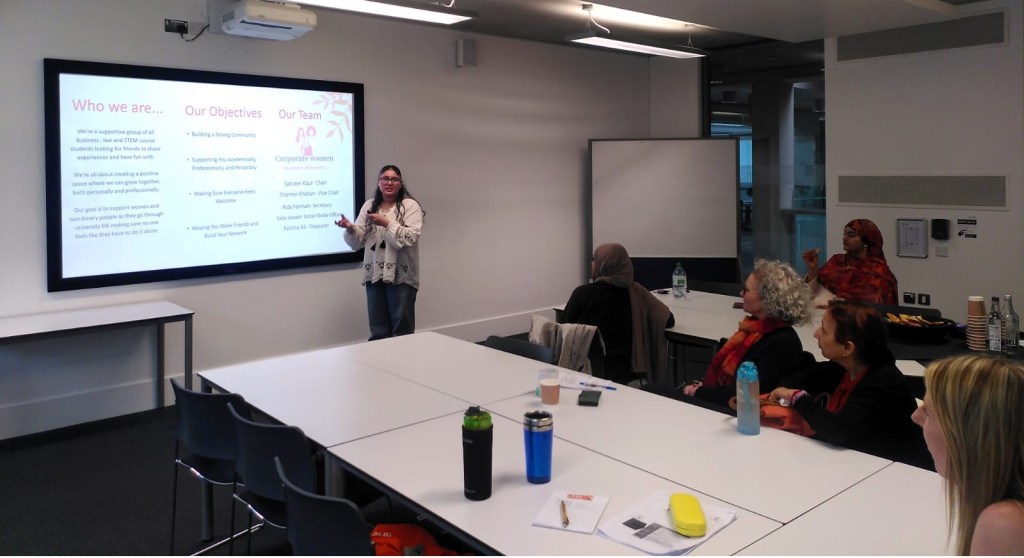
These presentations were followed by the Corporate Women Society who reflected positively on their success as a newly created society. Satveer concluded the presentations by sharing the Manifesto For Change in the Economics Degree. She argued for reforms enshrining equality by calling on educators to challenge and sanction inappropriate and disrespectful comments made in class while ensuring that female economics students get to contribute equally to class discussions. Educators must also introduce diversity and pluralism into the economics discourse incorporating a diverse set of theories, methodologies and faces, including women and marginalised groups into the curriculum. The provision of free period products throughout the business school was also mentioned under the notion of practicing inclusion by considering basic needs for female students. As always, the event concluded with a lively discussion where students, presenters and Hannah Holmes exchanged ideas and experiences.
This concluded our WEMS events for the previous academic year. We would like to take the opportunity to thank the F&E department for their support in bringing this idea to life. We would also like to thank the Corporate Women Society which has, in its establishment and support, exceeded all our expectations. A big thank you also goes out to all our female presenters and supporters who have given their time and energy to come and present their work, participate in discussions, share their experiences and create that space for female students, academics and practitioners to come together. Building on last year’s success, WEMS returns in the new academic year with a vision to widen participation and to expand our growing network across the north of England. Our first introductory event will be held on 24 September welcoming our new (and old) female economics students (back) to MMU.
Dr Sophia Kuehnlenz & Dr Julia Jeyacheya
 Finance & Economics Hub