


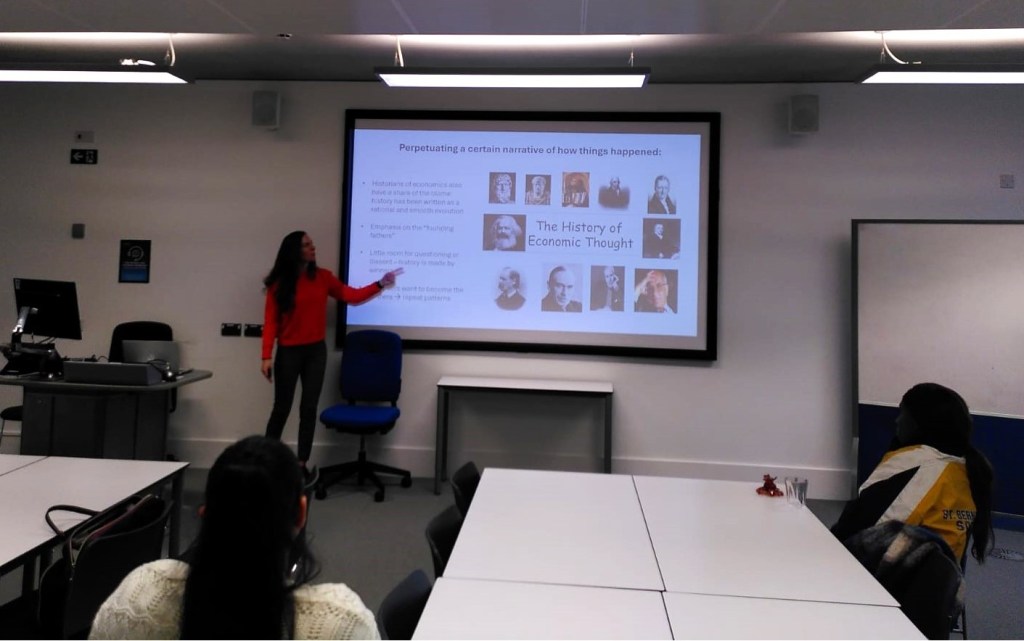
The third WEMS event welcomed Danielle Guizzo (Associate Professor in Economics Education, University of Bristol). Danielle presented research on “herstories”, or the lack thereof, within the economics discipline. The fact that attending female students and academics were not able to name three leading female economists was a case in point. The issue of missing(gender) diversity, in economics, among others, is an all-encompassing one, stretching across different schools of economic thought, time and space. It is deep-rooted in a discipline where the pursuit of specialization and scientific expertise has led to exclusionary structures and practices in the creation and dissemination of knowledge. With a focus on its “founding fathers”, economics as a whole has essentially deleted female economists and their contributions from the field.
While recent attempts have been made to include “herstories” into the economics discourse, intersectionality (such as ethnicity, sexual orientation, nationality and region, religion and others), although important, is still missing from the discussions. The question of why we should be concerned about diversity within economics inevitably arises. As pointed out by Danielle and others and linking to our second event, the lack of diversity within the discipline affects how economics and related policy studies analyse the world around us while also proposing potential policies. Viewing the world in a light that is only true for a minority leaves analyses based on this narrow approach to be approximate at best, and very questionable at worst.
It should then come as no surprise that, with women missing in key policy debates and key decision maker positions, progress on women’s rights is stalling whereas hard won victories for women’s rights are being reversed. According to the UN Women’s report, in 2024 nearly a quarter of governments worldwide reported a backlash on women’s rights. In 2025 we are observing the active dismantling of DEI initiatives affecting women, particularly through the lens of intersectionality, negatively. Thus, economics has to be more inclusive if this social science is to deliver for all and not just the few. Danielle notes that, if inclusivity is the aim, we have to establish engaged pluralism, where we not simply allow multiple different views to co-exist, but where we actively engage with them, maintaining and stimulating the necessary spaces for pluralism to exist. Further, economics needs to be democratised where the broader social image of economists is changed (white, male expert) towards an image that is representative of society. Lastly, so Danielle argues, inclusivity must become a principle and a practice within the field. Therefore, with economics being a science to promote social betterment, the focus should shift from efficiency to equality.
The question of course is whether we can foster new forms of knowledge and community practices that prioritise these different social goals. Spaces like WEMS aim to offer all three of these aims by promoting lived pluralism, by attempting to change the face of economics and by challenging long-established beliefs. We hope that this in turn will create stepping stones for change, to not only address the gender imbalance in economics but to also in fostering economic policies considerate of gender equality and women’s rights.
The third WEMS event concluded with a fruitful discussion on how to maximise the opportunities for female economists studying at university to raise their voices (literally and figuratively) in the present and the future.
Dr Sophia Kuehnlenz & Dr Julia Jeyacheya


Posted by Jessica Reynolds, Blog Interviewer & Content Creator
If you’d like to be involved in a future blog post, please do reach out: J.Reynolds@mmu.ac.uk
 Finance & Economics Hub